Every day, Crux asks ChatGPT, Perplexity, Google AI Overviews and Google AI Mode
the questions your buyers ask. See whether they name you, how you stand against
your competitors, and which pages they cite.
In alpha · ChatGPT · Perplexity · Google AI Overviews · Google AI Mode · An
EMIAC product
A buyer asks
Four engines answer
Every day
Coverage climbs
The market moves
Niche to Leader
The real app, filmed with sample data. GitHub and its rivals are real companies
used as an example; the figures are not measurements of them.
Engines
ChatGPT, Perplexity, AI Overviews, AI Mode
How often
Every question, every day
Setup
Three steps, from your website
Status
In alpha
01Why it matters
The shortlist is written before the first click.
A buyer asks an AI which tool to choose. The answer names a handful of brands
and cites a few pages, and that is where the shortlist starts.
Your search rankings cannot tell you whether you were in that paragraph, or
who was named before you. Crux can.
best code hosting platform for a small startup team
Asked in
For a small startup team,
GitHub
is the usual default: free private repositories and Actions in one place.
GitLab
bundles CI/CD, and
Bitbucket
fits teams already on Jira.
DEV
CommunityStack Overflow Bloggithub.com
Brands named
3
Your position
1st
Cited your site
Yes
Sample answers, for illustration. GitHub and its rivals are real companies
used as an example.
Questions like these, asked every day
best code hosting platform for a small startup teamAsked daily
in ChatGPT
how do remote teams review pull requestsAsked daily in
Perplexity
git platform with ci cd built inAsked daily in Google AI
Overviews
best place to host an open source projectAsked daily in Google
AI Mode
self hosted git server for a small companyAsked daily in
Perplexity
which git platform has the best free plan for private reposAsked
daily in Google AI Mode
how to manage code reviews across many repositoriesAsked daily
in ChatGPT
best way to run tests on every pull requestAsked daily in Google
AI Overviews
Sample questions from a demo workspace for GitHub.
02How it works
From your website to your standing.
Pick your brand and rivals
Enter your website, and Crux suggests the competitors to measure you
against. They are a starting point, not a finding: edit, delete and add
until the list is right.
Your brand's name and its domain
Competitors suggested from your site
A country and a language for what you measure
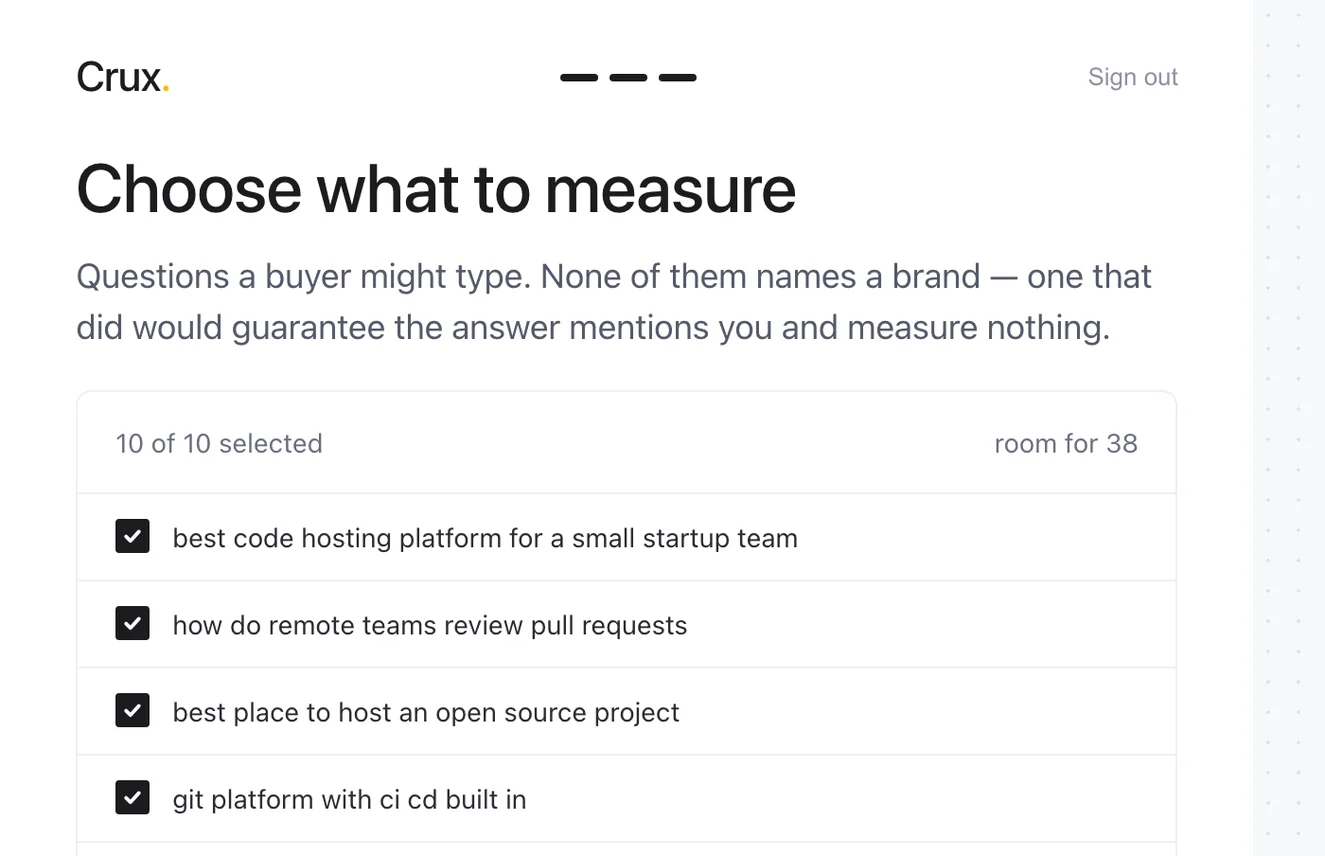
Questions, written for you
Crux writes the questions a buyer might type. None of them names a brand,
because a question that did would guarantee a mention and measure nothing.
Keep them, drop them, or add your own
Import a list from a file
Research new ones from SEO keywords you rank for
Asked every day
Each question goes to ChatGPT, Perplexity, Google AI Overviews and Google
AI Mode every day. Every answer is kept with its date, the brands it
named, and whether it cited your site.
ChatGPT, Perplexity, Google AI Overviews and AI Mode
Every answer kept, dated and readable
A failed capture is marked failed, not counted as zero
See where you stand
Coverage over time against each competitor, with the questions and the
answers behind every figure kept alongside it.
Filter by engine and by date range
Mentions and average position, side by side
The same numbers as a table, one press away
The real app, with sample data.
03Coverage and competitors
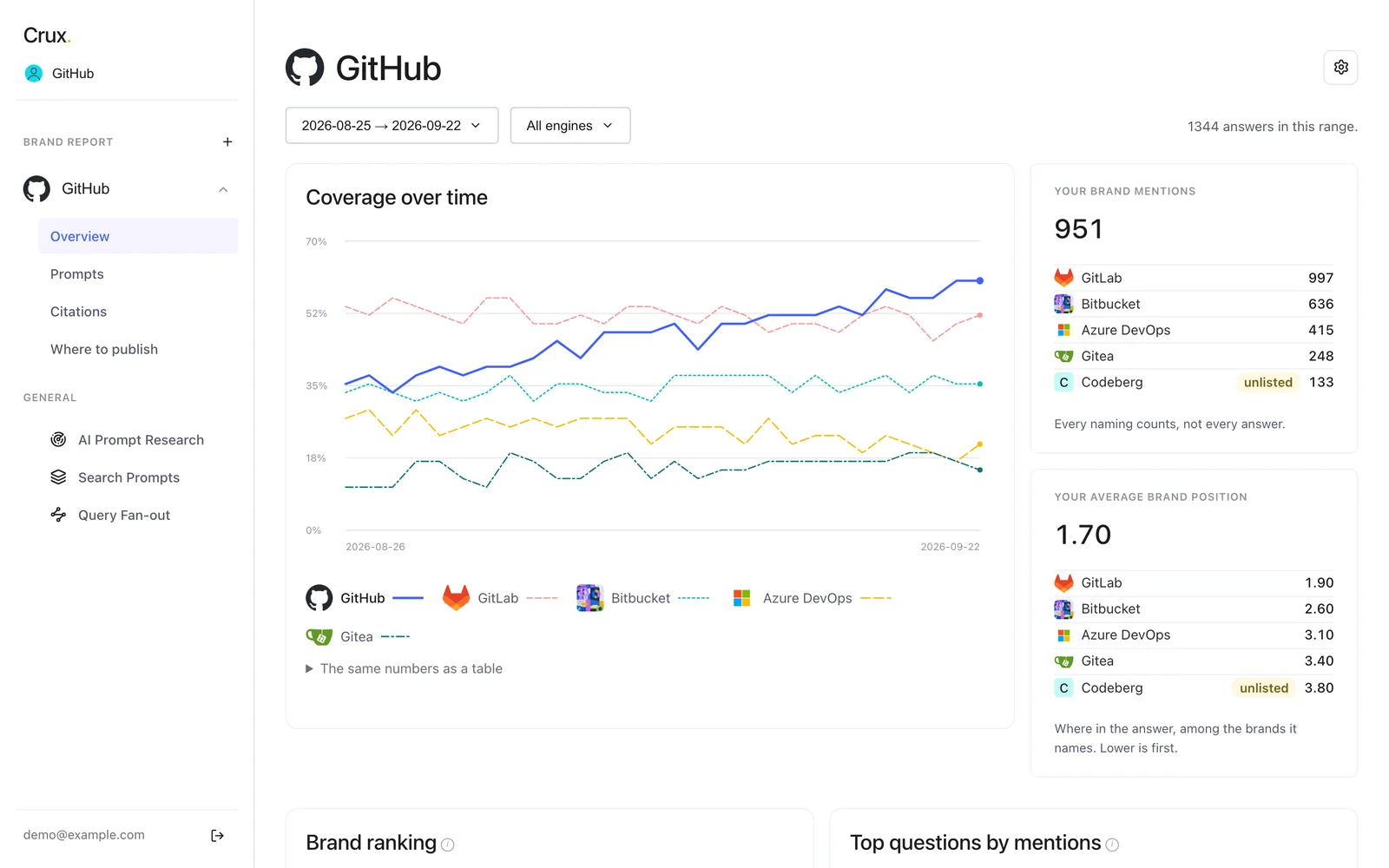
Your standing, against every rival.
How often the answers name you, beside the brands you compete with, and
which of your questions name you most.
Coverage over time, for every brand
A ranking by share of voice, with the tone of each mention
Your average position: how early in the answer you are named
Brands you never listed, tagged unlisted rather than dropped
The real app, filmed with sample data. Sentiment is a model’s reading of
tone, not a measurement.
04Answers and sources
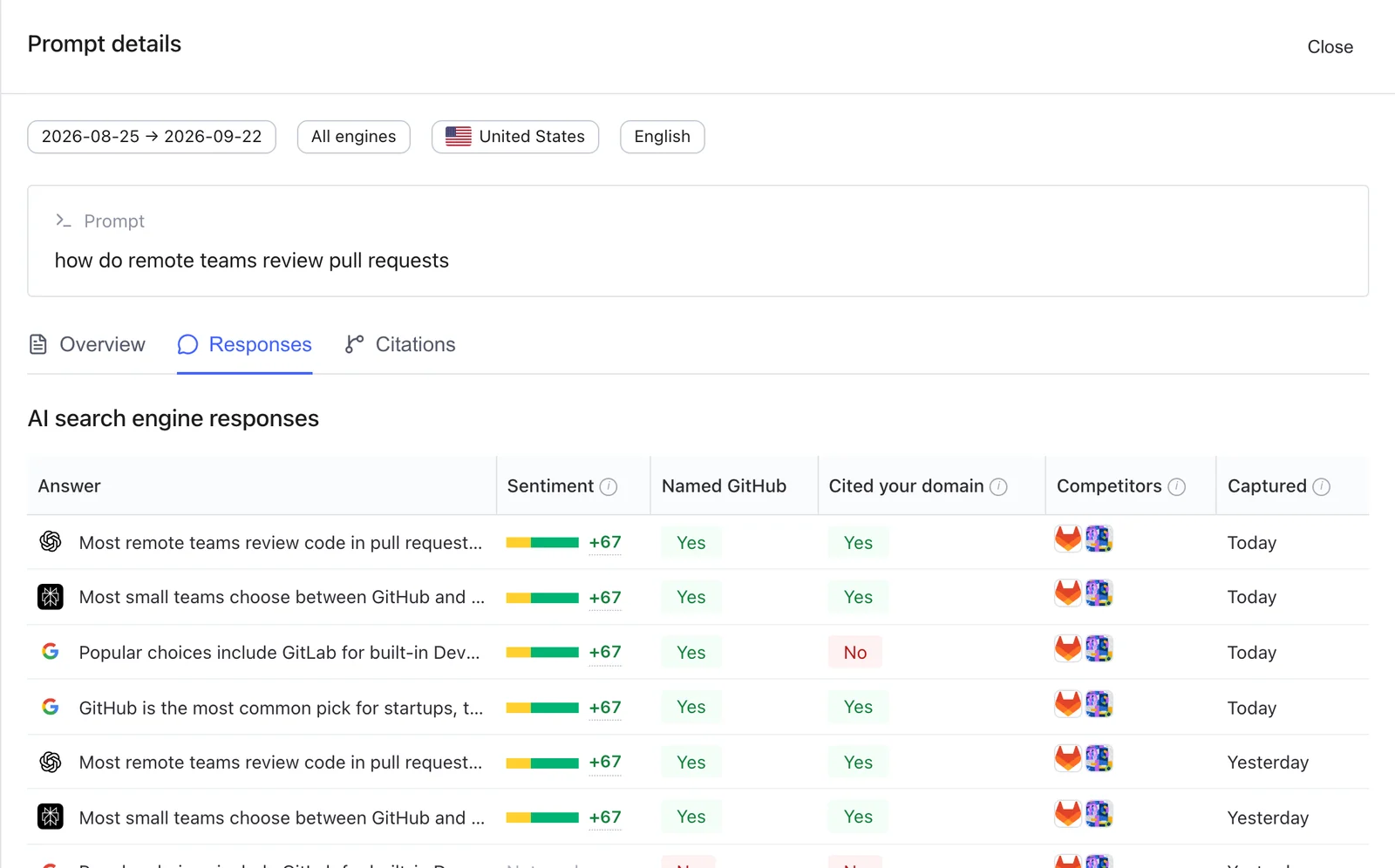
Read the answer. See what it cited.
Open any question to read what each engine said, which brands it named, and
the pages it drew on, each marked where the answer used it.
The answer's text, with the brands it named
Sources marked inline, where they were used
Which engine answered, and on which day
The searches the engine ran to write it
The real app, filmed with sample data.
The pages behind an answer
Gaining and slipping
Where to publish
Where a rival leads
The real app, filmed with sample data.
05Citations
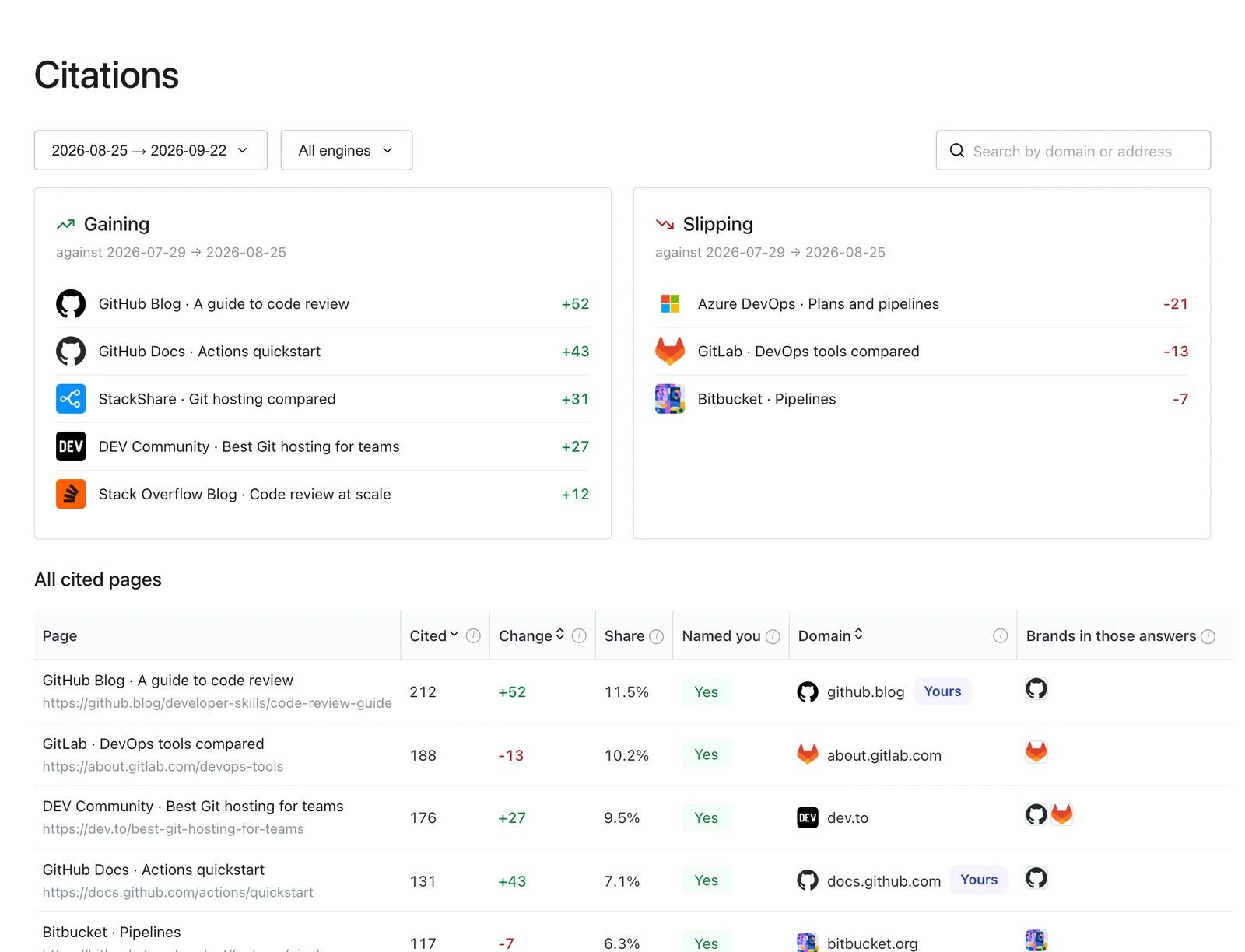
Pages gaining, pages slipping
Which pages the answers cite more than in the period before, and which they
cite less. Your own pages are marked as yours.
Sample data
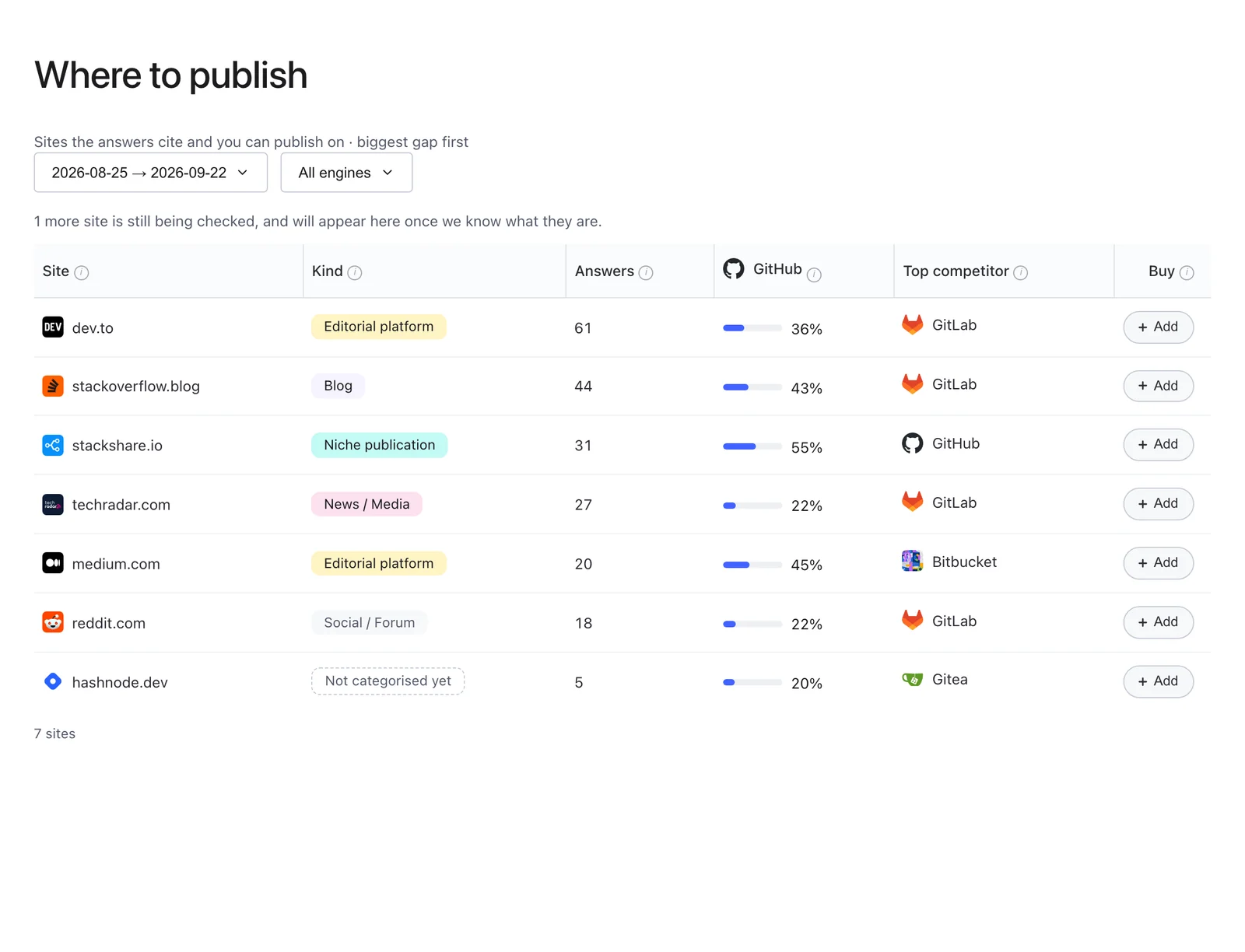
06Where to publish
Where a new page would count
The sites the answers cite that you can publish on, biggest gap first, with
the kind of site each one is.
Sample data
07Prompt research
Find the questions worth tracking.
Keep every question in one library, with its tags and its market. Add your
own, import a file, or research new ones from what you already have.
Tags and a market for every question
Research from SEO keywords, or from your brand and what it sells
Query fan-out: the searches each engine may run behind a question
Pause a question you no longer need
The real app, filmed with sample data. Fan-out results are a model’s
predictions, as the app labels them.
08Engines
Every answer engine your buyers use.
Crux asks ChatGPT, Perplexity, Google AI Overviews and Google AI Mode the same
questions, every day. Read them together, or filter any report to one engine
and see where each one puts you.
Every figure is counted from answers Crux captured, and every answer is
there to read.
How Crux counts
answers naming you ÷ all answersCoverageThe share of answers that name your brand. An answer that names you five
times counts once.
your mentions ÷ every brand’s mentionsShare of voiceYour mentions, as a share of every mention of the brands in those
answers.
average rank among the brands namedPositionWhere you appear among the brands an answer names, averaged. Lower is
earlier.
named you first ÷ named youNamed firstOf the answers that name you, the share that name you before any other
brand.
Five sample answers to “best code hosting platform for a small
startup team”. Pick a number to see what it counts.
Crux also shows sentiment: a model's reading of an answer's tone. It is an
estimate, not a measurement, and a brand nobody read for tone shows n/a rather
than zero.
10Who it is for
For the people who own being found.
Marketing leads
Whether AI answers put your brand on the shortlist, tracked day by day
against the rivals you name.
Content and SEO teams
The pages the answers cite, and the sites where a new piece could close the
gap.
Founders
How the answers describe your category, before a buyer ever reaches your
site.
Agencies
A report for each brand you look after, with the answers and sources behind
every number.
11Reviews
What teams say about Crux.
Sample reviewCoverage
“We had no idea ChatGPT named two rivals before us for our main
category. Now we check it every Monday.”
MMarketing leadB2B software
Sample reviewWhere to publish
“The list of sites the answers cite told us which three to pitch. That
became the content plan for the quarter.”
CContent leadMarketing agency
Sample reviewVisibility index
“We played back the month and watched ourselves move from niche to
leader. For the first time we could show the board it was working.”
HHead of SEOSaaS company
Sample reviewAnswers
“Being able to read the actual answer behind a number is what got our
founder to trust it.”
FFounderFintech startup
Sample reviewUnlisted brands
“It found a company we had never listed. It was named ahead of us in
half the answers.”
GGrowth leadOnline retailer
Sample reviewBrand reports
“One report per client, with the answers and sources behind every
figure. The monthly review writes itself.”
AAgency ownerSearch agency
Sample reviewQuestions
“The questions it wrote were better than ours, because none of them
names a brand.”
SSEO managerMarketplace
Sample reviewEngines
“Seeing four engines side by side showed us they describe us
completely differently.”
DMarketing directorSaaS company
Questions
What is Crux?
An EMIAC product that tracks, every day, whether ChatGPT, Perplexity, Google
AI Overviews and Google AI Mode name your brand for the questions your
buyers ask. It shows your coverage against competitors, the sources behind
each answer, and where to publish. It is in alpha.
Which AI engines does it cover?
ChatGPT, Perplexity, Google AI Overviews and Google AI Mode. Every question
is asked in each of them, every day, and every report can be read together
or one engine at a time.
How often are the questions asked?
Every day. Each answer is kept with its date, so coverage is a line over
time rather than a single snapshot.
Where do the questions come from?
During setup, Crux writes a starting set from your website, and you keep,
drop or add to them. You can also import your own, or research new ones from
SEO keywords you already rank for.
What happens when a capture fails?
It is shown as a failure, never as zero. A bad day for the capture never
looks like a bad day for your brand.
Are all the numbers measured?
Coverage, share of voice, position and named first are counted from the
answers Crux captured. Sentiment is a model's reading of tone: an estimate,
not a measurement.
What does it cost?
Crux is in alpha and has no public pricing yet.
Request early access
and we will talk it through.
See whether AI names you.
Crux is in alpha. Tell us your brand and the rivals you want to be measured
against, and we will be in touch.

 GitHub
is the usual default: free private repositories and Actions in one place.
GitHub
is the usual default: free private repositories and Actions in one place.
 GitLab
bundles CI/CD, and
GitLab
bundles CI/CD, and
 Bitbucket
fits teams already on Jira.
Bitbucket
fits teams already on Jira.
 DEV
Community
DEV
Community Stack Overflow Blog